
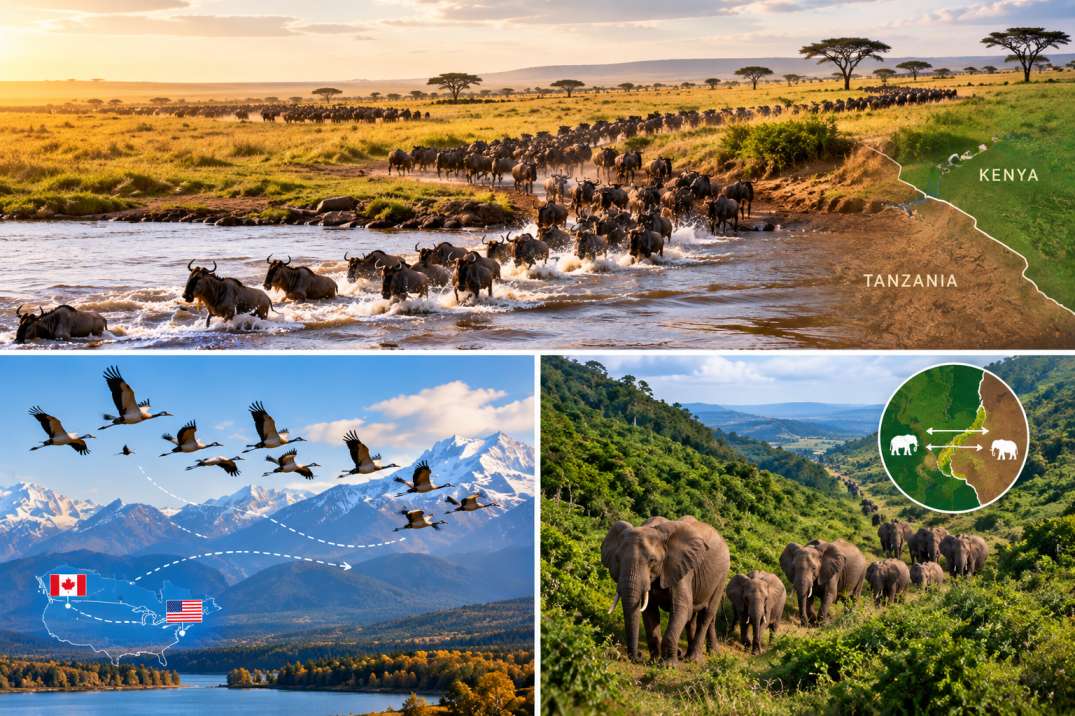
Imagine travelling from one country to another without a passport, visa, ticket, or border check. For humans, crossing an international border usually requires documents and permission. But for wild animals, crossing borders is a normal part of life.
Every year, millions of animals move between different regions in search of food, water, suitable temperatures, breeding grounds, and safer places to live. Some birds travel thousands of kilometres across continents, while elephants walk between countries in search of food and water. Whales move through international waters, and sea turtles cross entire oceans during their lives.
These journeys are known as wildlife migration. They connect different countries and ecosystems in ways that people do not always notice.
Interestingly, the political borders shown on maps mean nothing to most wild animals. A herd of elephants may move from one country to another because the landscape, water sources, and vegetation continue across the border. Birds may fly over several countries during a single migration season.
However, these journeys are becoming more difficult in some places because of roads, fences, cities, habitat destruction, and climate change.
In this article, we will explore fascinating examples of animals that cross international borders naturally and discover why their journeys matter for the planet.
1. What Is Wildlife Migration?
Wildlife migration is the regular movement of animals from one region to another, often at particular times of the year.
Animals migrate for different reasons. Some move to find food, while others travel to reproduce or escape extreme weather conditions. Certain species follow seasonal patterns that have developed over thousands of years.
Migration can happen over short distances or across entire continents.
For example, some animals move between nearby forests and grasslands. Others travel across deserts, mountain ranges, oceans, and national borders.
Not every animal movement is technically migration. Some animals regularly move around large home ranges without following a seasonal migration route. Others travel long distances only when conditions change.
Nevertheless, these movements show how wildlife depends on connected landscapes.
A national border may separate two countries politically, but the natural environment on either side can be part of the same ecosystem.
This is why wildlife conservation often requires cooperation between neighbouring countries.
2. Elephants That Move Between Countries
Where to find them: Parts of southern and eastern Africa
Examples of countries: Botswana, Namibia, Zimbabwe, Zambia, Kenya, and Tanzania
Elephants are among the most impressive land animals in the world. They are also capable of travelling considerable distances in search of food and water.
In parts of Africa, elephant populations move across landscapes that extend into multiple countries.
For example, elephants in the Kavango–Zambezi region can travel through connected habitats across Botswana, Namibia, Zambia, Zimbabwe, and Angola.
These countries are part of a wider conservation landscape known as the Kavango–Zambezi Transfrontier Conservation Area, commonly called KAZA.
The area was established to encourage cooperation in protecting wildlife and supporting connected ecosystems across national boundaries.
Why do elephants travel so far?
One important reason is the availability of water. Elephants need large quantities of water and may travel considerable distances to reach rivers, waterholes, and other reliable sources.
Food is another factor. Elephants eat grasses, leaves, bark, fruit, and other plant material. As vegetation changes with the seasons, they may move to areas where food is more plentiful.
Their movements also depend on rainfall, temperature, human activity, and the availability of safe habitat.
However, international movement can become difficult when fences, roads, farms, or settlements block traditional routes.
Elephants may enter agricultural areas while searching for food or water, creating conflict with local communities.
Conservation programmes therefore try to protect wildlife corridors, which are connected strips of habitat that allow animals to move between larger natural areas.
Interesting fact: An elephant does not recognise a national border as a political boundary. Its movements are influenced mainly by food, water, habitat, and safety.
3. Wildebeest: One of Africa's Greatest Wildlife Journeys
Where: Tanzania and Kenya
Famous location: Serengeti–Mara ecosystem
The annual movement of wildebeest across parts of East Africa is one of the world's best-known wildlife spectacles.
Large numbers of wildebeest move through the Serengeti ecosystem in Tanzania and the Maasai Mara region of Kenya.
This movement is often called the Great Migration.
Wildebeest are grazing animals, and their movements are closely linked to rainfall and the growth of fresh grass. As conditions change, herds travel to areas where food is available.
Their journeys can also involve zebras and other grazing animals.
The exact route and timing vary from year to year because rainfall does not follow precisely the same pattern every season.
During the migration, animals may cross rivers, travel through grasslands, and face predators such as lions, crocodiles, and hyenas.
River crossings receive particular attention because they can be dangerous. However, the migration is much more than a series of dramatic crossings. It is a continuous movement through a large ecosystem.
The Serengeti–Mara region includes protected areas on both sides of the Tanzania–Kenya border.
Because wildlife does not remain inside one national park, conservation requires countries to protect habitats and coordinate their management.
The migration also supports tourism and local employment, making the health of the ecosystem important for people as well as animals.
Interesting fact: The Great Migration is not a single journey with a fixed starting and finishing point. It is a repeating cycle influenced strongly by seasonal rainfall and grass availability.
4. Birds That Travel Across Continents
Birds are among the most remarkable long-distance travellers in the animal kingdom.
Many species migrate between breeding grounds and warmer regions during different seasons. Their journeys may take them across multiple countries, mountain ranges, deserts, and oceans.
One example is the Arctic tern, famous for its extraordinary long-distance migration between Arctic breeding areas and regions near Antarctica.
Depending on the route and population, its annual journey can cover tens of thousands of kilometres.
Another example is the bar-tailed godwit. Some populations undertake exceptionally long nonstop flights across the Pacific Ocean during migration.
These birds demonstrate how migration connects distant parts of the world.
Birds may breed in one country, rest in another, and spend the winter in a third. Some also depend on wetlands or coastal areas where they can feed before continuing their journeys.
For example, migratory birds visiting South Asia may use wetlands, lakes, and coastal habitats as important feeding and resting locations.
If one of these locations disappears, birds may struggle to complete their migration successfully.
This is why international agreements and protected wetland networks are important.
The Ramsar Convention, an international agreement focused on wetlands, supports the conservation and wise use of wetlands that many migratory birds depend on.
Bird migration is also influenced by weather, daylight, wind conditions, and food availability.
Interesting fact: Some birds travel between opposite ends of the planet during a year, connecting ecosystems separated by thousands of kilometres.
5. Monarch Butterflies and Their Remarkable Migration
Where: Canada, the United States, and Mexico
Butterflies may look delicate, but some species complete surprisingly long journeys.
The monarch butterfly is one of the most famous examples.
Many monarch butterflies in eastern North America travel south during autumn, eventually reaching overwintering forests in central Mexico.
Their migration connects Canada, the United States, and Mexico.
What makes this journey particularly fascinating is that the complete migration cycle involves multiple generations.
Butterflies travelling north during spring may reproduce along the way. Their descendants continue the journey, and later generations move farther north.
The generation that travels south in autumn has a different life history from the shorter-lived generations that reproduce during warmer months.
Scientists have studied how monarch butterflies use environmental cues and internal biological mechanisms to help guide their movements.
Their journey depends on suitable habitat, including milkweed plants used by monarch caterpillars and nectar-producing flowers that provide food for adult butterflies.
Habitat loss, pesticide exposure, extreme weather, and changes to breeding and overwintering areas can affect monarch populations.
Conservation efforts therefore need to protect habitats across several countries rather than focusing on only one location.
The monarch migration demonstrates that even very small animals can depend on international cooperation.
Interesting fact: Monarch butterflies that overwinter in Mexico are part of a migration system involving several generations, rather than one individual butterfly completing the entire annual cycle.
6. Sea Turtles That Cross International Waters
Where: Tropical and subtropical oceans around the world
Sea turtles spend much of their lives in the ocean, and some species travel vast distances between feeding areas and nesting beaches.
A sea turtle might hatch on a beach in one country, travel through international waters, feed in the waters of another country, and later return to a nesting region.
Green turtles, loggerhead turtles, leatherback turtles, and other species have different migration patterns.
For example, leatherback turtles are capable of travelling across entire ocean basins. Their movements can connect nesting beaches and feeding areas separated by thousands of kilometres.
Female sea turtles generally return to land to lay their eggs, often at beaches within the broader region where they originally hatched. However, the details differ by species and population.
Scientists use satellite tracking and other research methods to understand their movements.
Why is this important?
Sea turtles face threats in several parts of their lives. They can become accidentally caught in fishing equipment, lose nesting habitat because of coastal development, or be affected by pollution and artificial lighting near beaches.
Protecting only the beach where a turtle lays its eggs may not be enough. The turtle also needs safe ocean habitats during the rest of its life.
International cooperation helps protect migration routes, nesting sites, and feeding grounds.
Interesting fact: A sea turtle's life can connect beaches, coastal waters, and international ocean regions across enormous distances.
7. Whales That Travel Between Oceans and Countries
Where: Oceans worldwide
Examples: Humpback whales and gray whales
Many whale species migrate seasonally between feeding grounds and breeding areas.
Humpback whales are a well-known example. Different populations follow different routes, but many travel from colder, food-rich waters towards warmer breeding areas.
For example, some humpback whale populations feed in Antarctic or subantarctic waters and migrate towards breeding areas in tropical and subtropical regions.
These journeys can connect the waters of several countries and international ocean regions.
Gray whales also undertake long migrations along the Pacific coast of North America. Some populations travel between northern feeding areas and breeding lagoons farther south.
Whales do not follow political boundaries. Their movements are influenced by food, water conditions, breeding behaviour, and other biological factors.
However, their journeys can bring them into contact with busy shipping routes, fishing operations, underwater noise, and pollution.
Collisions with ships and entanglement in fishing gear are important threats for some whale populations.
Countries can help by coordinating research, reducing risks in important habitats, and establishing protective measures in areas where whales regularly travel.
Whale migration also supports tourism in some coastal regions, providing opportunities for people to observe these animals responsibly.
Interesting fact: A whale may spend one season feeding in cold waters and another season breeding in warmer waters, travelling across large distances between the two.
8. How Do Animals Know Where to Go?
One of the biggest questions about animal migration is how animals navigate such long distances.
Humans generally use maps, road signs, phones, or navigation systems. Wild animals, however, rely on a combination of natural abilities.
The exact methods differ between species, and scientists are still studying many details.
Using the Sun
Some animals use the Sun's position as a navigation cue.
Because the Sun appears to move across the sky throughout the day, animals may combine its position with an internal biological clock to help maintain direction.
Using the Stars
Certain migrating birds can use patterns in the night sky as part of their navigation system.
This ability can help them maintain a general direction during long nighttime journeys.
Detecting Earth's Magnetic Field
Research suggests that some animals can detect information from Earth's magnetic field.
This may provide directional information during migration, although the biological mechanisms vary and are not fully understood in every species.
Following Rivers, Coastlines, and Mountains
Landmarks can also help animals navigate.
Birds may travel along coastlines or mountain ranges, while land mammals may follow established routes between water sources and grazing areas.
Following Seasonal Conditions
Many migrations are influenced by temperature, rainfall, daylight, and food availability.
Animals may begin moving when conditions signal that it is time to breed, find food, or avoid unfavourable weather.
In reality, animals often combine several navigation methods rather than relying on just one.
9. How Human Borders Affect Wildlife
Although international borders do not mean much to wild animals, human infrastructure can affect their movements.
Roads, fences, railway lines, farms, and expanding cities can divide habitats that were once connected.
When an animal's traditional migration route becomes blocked, it may have to find another route or remain in an area with insufficient food or water.
This can create problems for wildlife and people.
For example, elephants may enter farms while searching for food. Large mammals crossing busy roads may be struck by vehicles. Animals that become trapped in isolated habitats may have fewer opportunities to find mates or establish new populations.
Climate change can create additional pressure by changing rainfall patterns, temperatures, and the distribution of food.
As a result, some species may need to move to different areas to survive.
What Are Wildlife Corridors?
Wildlife corridors are areas of connected habitat that allow animals to travel between larger natural areas.
They can include forest strips, grasslands, riverbanks, and other landscapes that animals can safely cross.
Corridors can help animals reach seasonal feeding grounds, find mates, and adapt to changing environmental conditions.
Why Is International Cooperation Important?
When wildlife crosses national borders, one country's conservation efforts may not be enough.
An animal might be protected inside a national park but face serious threats after moving into another country.
International agreements, shared scientific research, coordinated habitat protection, and cooperation with local communities can help address these challenges.
Protected areas that extend across borders are particularly useful because they recognise that ecosystems do not always fit neatly within political boundaries.
Important point: Wildlife conservation works best when countries protect the connected habitats animals actually use, rather than treating each national border as the edge of an ecosystem.
10. Interesting Facts About Wildlife Migration
Here are ten facts that show how remarkable animal migration can be.
1. Some birds migrate between the Arctic and Antarctica.
The Arctic tern is famous for its exceptionally long annual migration.
2. Elephants may travel between several countries.
In parts of southern Africa, connected habitats allow elephants to move across international boundaries.
3. The Great Migration connects Tanzania and Kenya.
Wildebeest and other grazing animals move through the Serengeti–Mara ecosystem in response to changing conditions.
4. Monarch butterflies migrate to Mexico.
Many monarchs from eastern North America travel south to overwintering forests.
5. Sea turtles cross international waters.
Their movements connect nesting beaches and feeding grounds across large ocean regions.
6. Whales migrate between feeding and breeding areas.
Some populations travel thousands of kilometres between different ocean environments.
7. Animals do not need political maps.
Their movements respond to natural conditions rather than human-drawn borders.
8. Migration routes can change.
Weather, food availability, habitat conditions, and human activity may influence where animals travel.
9. Small animals can make enormous journeys.
The monarch butterfly demonstrates that long-distance migration is not limited to large animals.
10. Wildlife protection often requires multiple countries.
When a species crosses borders, protecting its complete migration route can be more effective than protecting just one location.
This is the information about the Animals That Cross International Borders Naturally: The Hidden Geography of Wildlife Migration. Please also Read the another article.